Tint Trestle
Tint Trestle is a calm daily sorting puzzle. Each of four rails holds six badges, each a colour and a shape with its name written on it. Two printed orders tell you how to sort: first group the badges by colour or by shape, then order them inside each group by the other feature. Insert badges into place and check each rail. There is no timer or move limit, and every rail has one correct order. Fewer checks and moves give a better result, saved with your streak in your browser.
How to play
Tap a badge, then the position where it belongs to insert it there, or use Move earlier and Move later. Tap a selected badge again or press Escape to deselect it. Keys 1 to 6 select positions, Left and Right arrows move the selected badge, and Escape deselects. Press Check rail, then Next rail or Finish daily.
Game credits
Provided by Nodavi Originals.
Available on desktop and mobile. An original Nodavi challenge. No third-party game bundle.
Ready when you are
Instant playA little break starts here.
An original daily challenge. Your streak stays on this browser. No ads or outside requests.
Nothing loads until you press Play.
The game opens here. Privacy & third-party games
Read the field guide: rules, tips & strategy ↓
How to Play Tint Trestle – Rules, Tips and Strategy
Tint Trestle is a calm daily sorting puzzle. Each day brings four short rails of six badges, and your job is to put every rail in the right order. Nothing is hidden and there is no timer: the rules for each rail are printed above it. Everyone in the world gets the same four rails on the same UTC day.
The badges
Every badge combines one colour and one shape:
- colours: Amber, Teal and Plum
- shapes: Ring, Kite and Arch
Each badge also has its name written on it, for example “Teal Kite”, so you never have to rely on telling colours apart. On every rail, the six badges are all different, and each colour and each shape appears exactly twice.
How a rail is sorted
Above each rail are two lines:
- First group by – either colour or shape, followed by an order such as “Plum, Amber, Teal”.
- Within each group – the other feature, with its own order.
Say the first line is group by colour: Plum, Amber, Teal and the second is shape: Arch, Ring, Kite. Then both Plum badges come first, followed by both Amber badges, then both Teal badges. Inside each colour pair, the badge whose shape comes earlier in “Arch, Ring, Kite” goes first.
The orders are chosen fresh for every rail, so do not assume alphabetical or rainbow order. Two of the four daily rails group by colour and two group by shape, in a shuffled sequence that can repeat on another day. Every rail has exactly one correct arrangement, and no rail starts already sorted.
Moving badges
Positions are numbered 1 to 6 in reading order. On a phone the rail wraps into two lines of three, so read across, then down.
- Tap a badge to select it, then tap the position where it should go. The badge is inserted there and the badges in between slide along to make room. This is not a swap. After an insertion the badge is deselected, so your next tap simply picks a new badge.
- Or select a badge and use Move earlier and Move later. These keep the badge selected, so you can nudge it several places in a row.
- On a keyboard, keys 1 to 6 select a position, the Left and Right arrows move the selected badge, and Escape deselects.
When you think a rail is right, press Check rail. A wrong check leaves your badges where they are. A correct rail is locked, and Next rail takes you on; after the fourth rail, press Finish daily.
Scoring
Your result counts the checks you used and the moves you made across all four rails. Each insertion counts as one move, however far the badge travels. Fewer checks and fewer moves are better. Four checks, one per rail, is the minimum; moves are counted separately, so avoid unnecessary insertions too.
A method that works
Build the groups first. Read the first line and get the two badges of the first group into positions 1 and 2, the next group into 3 and 4, and the last into 5 and 6. Do not worry about the order inside each pair yet.
Then fix each pair. For each pair, check the second line and swap the two badges if needed. Because each pair only has two badges, this is at most one move per pair.
Insert to the far end. Insertion lets a badge travel any distance for one move. Moving a badge straight to its final place is cheaper than nudging it step by step.
Read the rail before checking. Everything you need is visible, so read positions 1 to 6 against both lines before you press Check rail. Done carefully, every rail needs only one check.
Streaks and sharing
Your first finished result and your streak are saved in your browser; no account is needed. Copy result copies the date, your checks and moves, the game name and a link, but never a colour, shape or position, so friends can solve the same rails without spoilers. Practice rounds do not change your first result. New rails start at 00:00 UTC; if the game is already open, reload it to get the new day.
For another untimed puzzle built on reading clues carefully, try Mote Ledger.
A little more to explore
All games ↗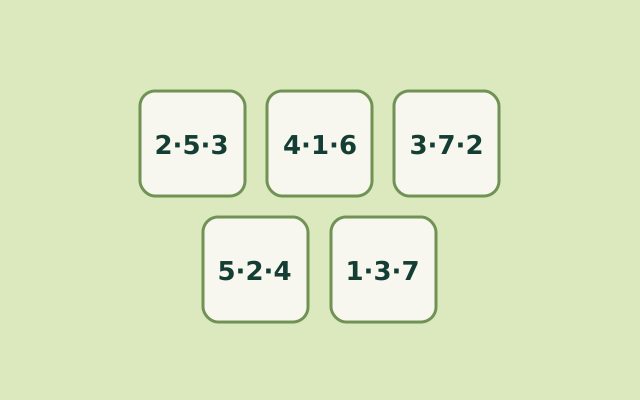 Mobile friendly
Parcel Prism
Parcel Prism is a short daily logic puzzle. Nine parcel cards each carry three numbers: Heat, Lift and Glow. The order at the top asks for an exact total of all three. Pick exactly four cards whose Heat, Lift and Glow add up to the order. Your running totals update as you select, and you can swap cards freely; only pressing Check order counts toward your score. Every board has exactly one solution. Everyone gets the same board each UTC day, your streak is saved in your browser, and you can copy a spoiler-free result to share.
 Mobile friendly
Vowel Ferry
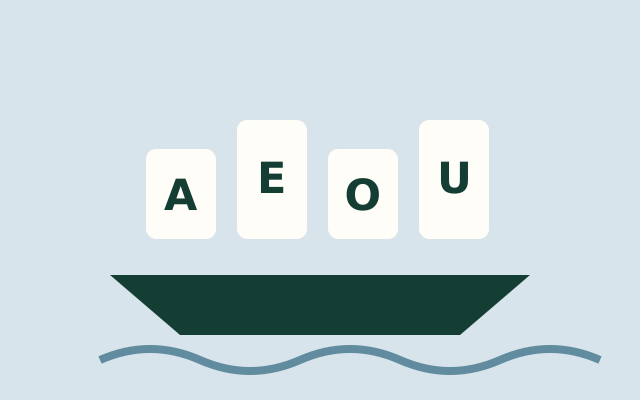
Vowel Ferry is a calm daily word puzzle. Six English words have each lost one vowel, and every word comes with a short definition. A shared cargo holds exactly the six missing vowels, with a counter for each of A, E, I, O and U. Select a word, then move a vowel from the cargo into its blank. Changing a letter sends the old vowel back. When all six blanks are filled, check the cargo; fewer checks means a better result. There is no timer and no guessing of hidden words. A new set arrives every UTC day and your streak stays in your browser.
 Mobile friendly
Gust Grove
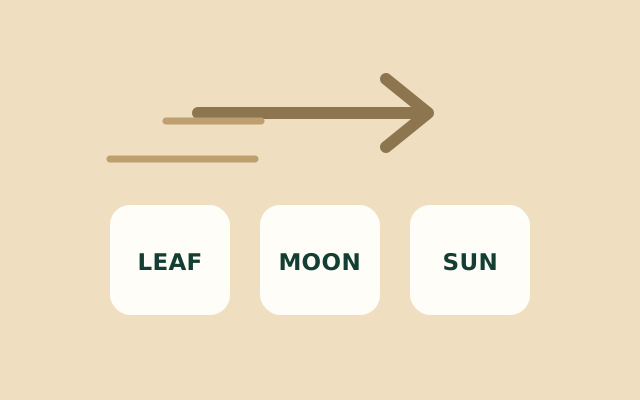
Gust Grove is a quick daily reflex game of 18 cues. Each cue names a symbol, Leaf, Moon or Sun, and shows three landing places in a new order. Find the symbol, then follow the wind: on a calm cue land on the symbol itself, on a left gust land one place to its left, on a right gust one place to its right. The ends wrap around. You have two seconds per cue, and your score is the number of correct landings out of 18. You can pause at any time, and hiding the tab pauses the game. Everyone plays the same route each UTC day.