Rill Rounds
Rill Rounds is a calm daily number puzzle. Three rings each carry five numbers, stacked so that every column forms a channel. Each channel shows its current total next to its goal. Rotate whole rings left or right, with numbers wrapping around the ends, until all five column totals match their goals at once. There is no timer, and every daily board has exactly one solution. Only checks count, so fewer checks means a better result. Everyone gets the same board each UTC day, your streak is saved in your browser, and you can share a spoiler-free result.
How to play
Tap the Left or Right button on a ring to rotate it. On a keyboard, press 1, 2 or 3 to select a ring, then the Left or Right arrow to rotate it. Press Check streams, or Enter on the board, to submit.
Game credits
Provided by Nodavi Originals.
Available on desktop and mobile. An original Nodavi challenge. No third-party game bundle.
Ready when you are
Instant playA little break starts here.
An original daily challenge. Your streak stays on this browser. No ads or outside requests.
Nothing loads until you press Play.
The game opens here. Privacy & third-party games
Read the field guide: rules, tips & strategy ↓
How to Play Rill Rounds – Rules, Tips and Strategy
Rill Rounds is a daily number puzzle about turning rings until five small streams are in balance. It has no timer and no luck once the board is dealt, and everyone in the world gets the same board on the same UTC day. This guide explains the rules, shows what the numbers on screen mean, and gives a method that lets you finish with a single check.
How to play
The board has three rings, shown as three rows. Each ring carries five numbers. Because the rows are stacked, each column of three numbers forms a channel, so there are five channels in total.
Above the rings is a line of five boxes, one for each channel. Each box shows two things: the channel’s current total (the three numbers in that column added together) and its goal. Your job is to make all five totals equal their goals at the same time.
- Each ring has a Left and a Right button. Pressing one shifts the whole ring by one place. A number that falls off one end comes back on the other, so a ring has exactly five possible positions.
- On a keyboard, press 1, 2 or 3 to choose a ring, then use the Left and Right arrow keys to rotate it.
- When you think the streams are balanced, press Check streams, or Enter while the board has focus.
Rotating is free. Only checks count toward your result, so a perfect day is one check. Restart for practice puts the rings back to their starting positions so you can try again, but your first finished result of the day is the one that counts toward your streak.
Things that are always true
A few facts make the puzzle much easier to reason about:
- There is exactly one solution. The daily board is built so that only one combination of ring positions balances all five channels.
- The starting position is never the answer. Every ring needs to move at least once.
- There are only 125 positions in total. Three rings with five positions each gives 5 × 5 × 5 combinations. That sounds like a lot, but you never need to try them all.
- The grand total never changes. Rotating a ring moves its numbers between channels; it never adds or removes anything. If you add up all five current totals, you always get the same number as the five goals added together. So you are not hunting for a total, only for the right distribution.
You can see the answer before you check
The current totals update the moment you rotate a ring, and a channel that matches its goal is highlighted. That means you can test as many positions as you like without spending a check. The only reason to check early is impatience. If you rotate until all five channels are highlighted and only then press Check streams, you will finish in one check every day.
A method that works
Pick a starting ring. A ring with a wide range of numbers is often a useful place to start, but look at how one rotation actually changes all five channels before you commit to it.
Use the extreme goals as clues. Find the channel with the highest goal and the one with the lowest. A high goal often comes from several large numbers lining up, and a low goal from small ones, but a large number in one ring can be balanced by small numbers in the others. Treat this as a hint for where to look first, not as a rule that rules positions out.
Work in differences, not totals. For each channel, note how far the current total is from its goal: for example +3, −2, 0, +1, −2. These differences always add up to zero, because the grand total is fixed. Rotating a ring by one place shifts each of its numbers into the neighbouring channel, so you can predict how the differences will change before you press anything.
Sweep one ring at a time. If you get stuck, fix the first ring in one position and turn the second ring through all five of its positions. For each of those, turn the third ring through its five positions and watch for a full match. That is at most 25 combinations per position of the first ring, and the highlights make a near miss easy to spot.
Check once. When all five channels are highlighted, press Check streams.
Common mistakes
- Checking to “see what happens”. A check gives you no information that the highlighted totals do not already show. Save it for the end.
- Moving a ring the long way round. Four steps right is the same as one step left. Use whichever direction is shorter.
- Fixing one channel at a time. Making channel 1 match and then moving on often breaks it again. Think about all five differences together.
Streaks and sharing
Your result and your daily streak are saved only in your browser, with no account needed. Copy result copies your saved first result of the day, with the UTC date, your number of checks, the game name and a link, but never the ring positions, so you can post it without spoiling the board for anyone else. Practice rounds do not change it. A new board starts at 00:00 UTC; if the game is already open, reload it to get the new day.
When you are done, try the other daily puzzles on Nodavi, such as Parcel Prism, which uses a similar idea of balancing several totals at once.
A little more to explore
All games ↗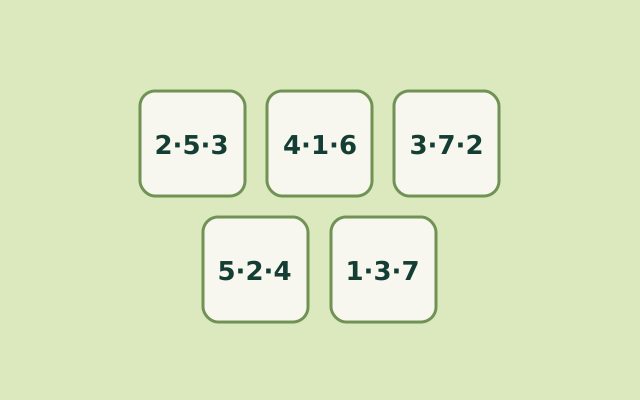 Mobile friendly
Parcel Prism
Parcel Prism is a short daily logic puzzle. Nine parcel cards each carry three numbers: Heat, Lift and Glow. The order at the top asks for an exact total of all three. Pick exactly four cards whose Heat, Lift and Glow add up to the order. Your running totals update as you select, and you can swap cards freely; only pressing Check order counts toward your score. Every board has exactly one solution. Everyone gets the same board each UTC day, your streak is saved in your browser, and you can copy a spoiler-free result to share.
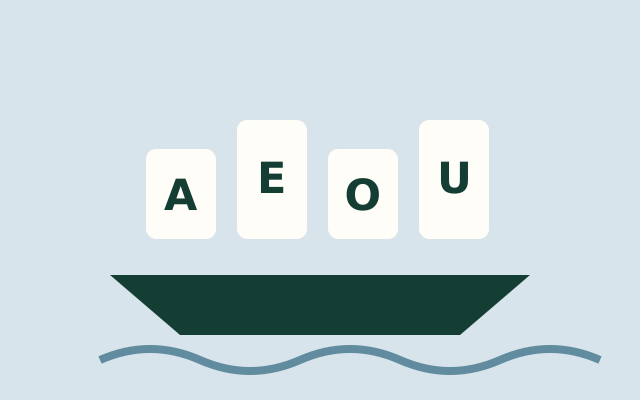 Mobile friendly
Vowel Ferry
Vowel Ferry is a calm daily word puzzle. Six English words have each lost one vowel, and every word comes with a short definition. A shared cargo holds exactly the six missing vowels, with a counter for each of A, E, I, O and U. Select a word, then move a vowel from the cargo into its blank. Changing a letter sends the old vowel back. When all six blanks are filled, check the cargo; fewer checks means a better result. There is no timer and no guessing of hidden words. A new set arrives every UTC day and your streak stays in your browser.
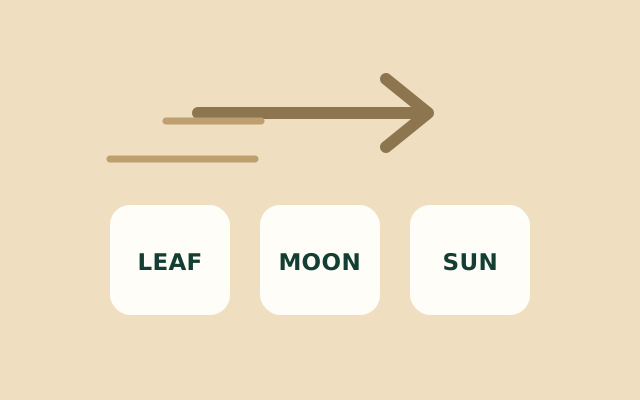 Mobile friendly
Gust Grove
Gust Grove is a quick daily reflex game of 18 cues. Each cue names a symbol, Leaf, Moon or Sun, and shows three landing places in a new order. Find the symbol, then follow the wind: on a calm cue land on the symbol itself, on a left gust land one place to its left, on a right gust one place to its right. The ends wrap around. You have two seconds per cue, and your score is the number of correct landings out of 18. You can pause at any time, and hiding the tab pauses the game. Everyone plays the same route each UTC day.